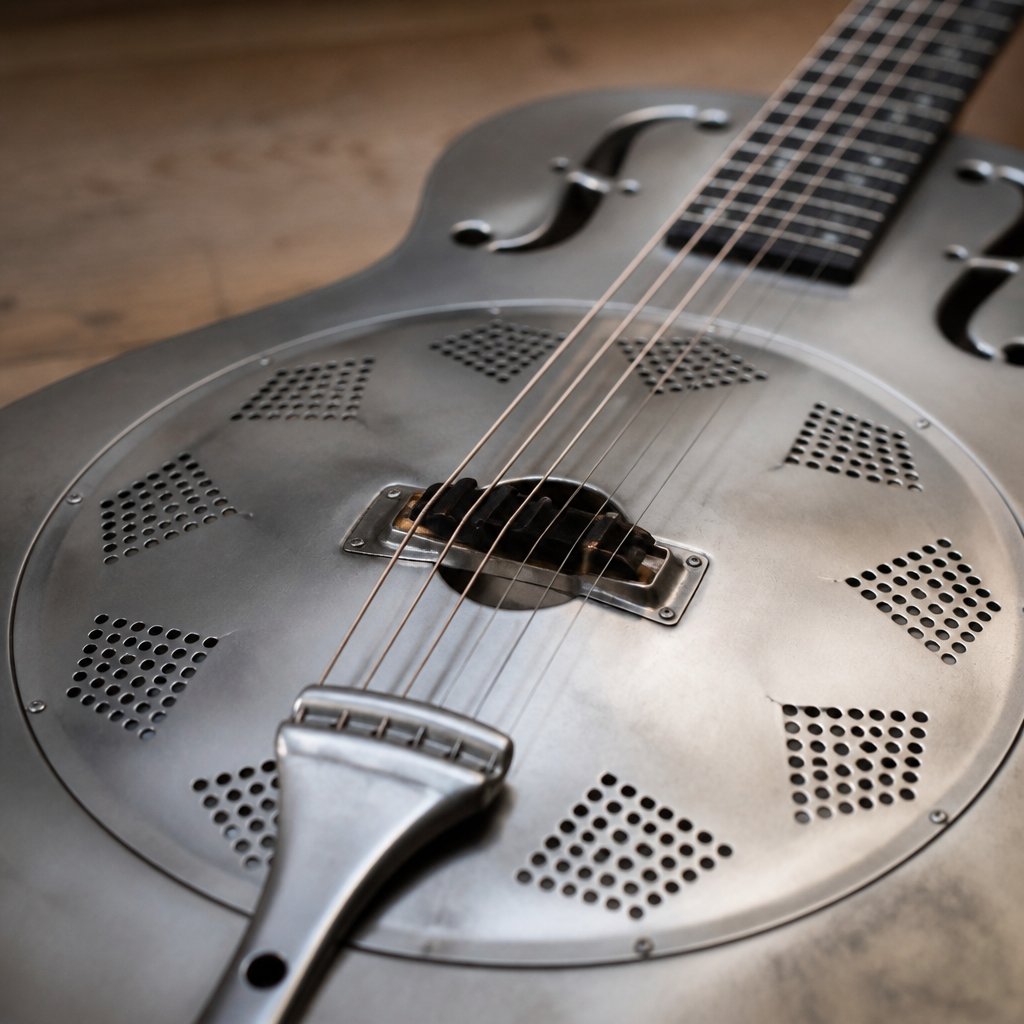
A resonator guitar solves an old problem with a mechanical answer. In the 1920s, a guitar could not be heard next to a banjo, a brass section or a room full of dancers, and amplification did not yet exist in any usable form. So instead of building a bigger wooden box, the Dopyera brothers put a spun aluminium cone inside the body and rested the bridge on it. The strings drive the cone, the cone drives the air, and the instrument becomes, in effect, a purely mechanical loudspeaker.
What actually makes the noise
On a normal guitar, the bridge transmits string vibration to a wooden top, which moves the air. On a resonator guitar the top is largely a lid. The bridge sits on a thin aluminium cone, usually about 9.5 inches across and only a few hundredths of a millimetre thick, and it is the cone that radiates the sound.
That single change gives the instrument its two defining qualities: volume, considerably more than a wooden guitar of the same size, and a metallic sustain with a fast, hard attack that no wooden top produces. It also makes the instrument sensitive in odd ways. A cone that is not seated properly, a loose coverplate screw or a rattling spider leg will show up as a buzz that no amount of setup elsewhere will cure.
The squareneck resonator at a glance
- Cone
- Spun aluminium, about 9.5 inches
- Bridge type
- Spider, eight legs on the cone rim
- Tuning
- GBDGBD, open G
- Neck
- Square, played flat on the lap
- Action
- Very high, deliberately
- Left hand
- A steel bar, never the fingers
- Right hand
- Thumbpick and two fingerpicks
Square neck or round neck
This is the first question in any shop and the one that decides what you can play.
A squareneck resonator has a solid neck with a square cross section and a tall nut that lifts the strings a centimetre or more clear of the frets. It cannot be fretted with the fingers at all. It lies flat on the lap, strings facing the ceiling, and the left hand holds a steel bar above the strings. This is the bluegrass instrument, tuned to open G, and the frets exist only as position markers.
A roundneck resonator has a normal guitar neck and normal action. It is played upright like any guitar, with fingers, or with a bottleneck slide on one finger. This is the blues instrument, and it is also the practical choice for a guitarist who wants the resonator sound without learning a new technique from scratch.
Converting a roundneck to lap playing is possible with an extension nut that raises the strings, and it is a reasonable way to try the style before committing. Converting a squareneck to normal playing is not possible.
The three cone designs
| Design | How it works | Sounds like | Usually found in |
|---|---|---|---|
| Spider bridge | One inverted cone with an eight legged aluminium spider on its rim | Woody, vocal, strong midrange | Bluegrass, on squareneck instruments |
| Biscuit bridge | One cone facing down, with a small wooden biscuit at its centre | Punchy, raw, immediate | Country blues, usually roundneck |
| Tricone | Three smaller cones linked by a T shaped bar | Sweeter, longer sustain, complex | Slide blues and Hawaiian style playing |
Body material is a separate choice again. A wooden body is standard for bluegrass. A metal body, brass or steel, adds sustain and cut and is the classic blues instrument. Neither is more authentic than the other, they simply belong to different rooms.
Open G, and the bar
Squareneck resonators are tuned to open G, written GBDGBD from the lowest string to the highest. Every open string is part of a G major chord, so laying the bar straight across any fret gives a full major chord in a new key: fret five is C, fret seven is D, fret twelve is G an octave up. That is the entire harmonic system, and it is why the instrument is easy to start and hard to finish.
The bar is a solid steel cylinder, and for squareneck playing it is usually a grooved bar designed to sit in the hand with the fingers curled over it. Blues players on roundnecks generally use a plain round bar or a bottleneck slide. Bar pressure is light: the bar rests on the strings and never presses them down to the frets.
Three techniques separate a beginner from someone who sounds like the instrument.
- Damping. The fingers of the left hand trail behind the bar, resting on the strings, killing every note the moment the bar leaves it. Without damping, a resonator guitar is a wash of noise. This is the first thing to learn and the last thing to master.
- Vibrato. A small oscillation of the bar along the string, not across it, added after the note has started rather than during the attack.
- Slants. Angling the bar so it covers two notes that do not lie on the same fret, which is the only way to reach many two note harmonies. Players call them forward and reverse slants, and the labels are used inconsistently from one method book to the next, so learn the sound and the hand position rather than arguing about the names.
Nobody has ever been let down by a resonator player who could damp cleanly. Everybody has been deafened by one who could not.
How it got into bluegrass
The resonator guitar was not in the first generation of bluegrass bands. It arrived properly in 1955, when Josh Graves joined Flatt and Scruggs and took the three finger roll patterns that Earl Scruggs was playing on the banjo and applied them to a squareneck resonator. That translation is the whole foundation of bluegrass dobro playing: the right hand comes from the banjo, the left hand comes from Hawaiian and blues steel playing, and the repertoire comes from the fiddle.
The instrument then sat quietly for two decades before a generation of players in the 1970s and 1980s expanded it into a lead voice capable of anything a fiddle can do. Today it is standard in a full bluegrass line up and increasingly common in Americana bands, where its ability to sustain behind a singer makes it a substitute for a pedal steel.
Your first three months on a squareneck
- Weeks 1 to 3. Straight bar across the strings at frets 5, 7 and 12, with clean damping behind it. No tunes at all.
- Weeks 4 to 6. Right hand rolls with thumb and two fingers, over open strings only, slowly.
- Weeks 7 to 10. One simple melody played on the top two strings, with the bar moving between positions and the notes stopping cleanly.
- Weeks 11 to 12. Vibrato added to long notes, and the first slant. Expect the slant to sound wrong for a month.
Buying a resonator guitar
Decide square or round first, because the two are not interchangeable and second hand values differ.
Roughly 350 to 700. Entry level instruments from the established import brands. Wooden body, spider cone, playable, and enough instrument for a first year or three. Check the cone seating and listen for buzzes before you buy, since that is where corners get cut.
Roughly 900 to 2,000. Better cones, better cone fitting, and a noticeable improvement in note separation. Several small workshops in the United States and Europe build in this range and a good one will outlast you.
Second hand. Buzzes are the thing to test for, and they are easy to test: play every string at every fifth fret with the bar and listen. Most buzzes are a loose screw or a badly seated cone and cost nothing to fix, but a warped cone is a replacement job.
Strings are heavier than on a normal guitar, because high action and bar pressure need tension, and squareneck sets typically run from about .016 to .056. A dobro strap that holds the instrument level on the lap is not optional if you ever intend to stand up.
If the naming has you confused, and it confuses everybody, the difference between a dobro and a resonator guitar is a trademark rather than an instrument. We untangle it in dobro or resonator guitar.
Common questions
Is a resonator guitar the same as a dobro?
Not quite. Dobro is a brand name, now a trademark held by Gibson, that has been used loosely for any spider bridge resonator. All Dobros are resonator guitars, but not every resonator guitar is a Dobro.
Can I play a squareneck resonator like a normal guitar?
No. The action is deliberately far too high to fret, and the neck is square so it cannot be held in a normal grip. If you want a resonator you can play conventionally, buy a roundneck.
Do I need to read music to play one?
No. Most players work from tablature, from recordings, or by ear. The instrument is tuned to an open chord, so the positions are learned as places on the neck rather than as written notes.
Why does mine buzz?
In order of likelihood: a loose coverplate or tailpiece screw, a spider leg not sitting flat on the cone, a cone that has been over tightened, or a string end rattling at the tailpiece. Almost none of it is expensive.
Is it hard compared with a guitar?
Easier to make a pleasant noise on, harder to play accurately. There are no frets under your fingers to put you in tune, so intonation is entirely your responsibility from the first minute, and cleaning up the noise between notes takes far longer than most people expect.
Where to go next
- Dobro or resonator guitar, the naming, the trademark and which one a shop actually means.
- The five string banjo, where the right hand roll patterns came from.
- Flatpicking guitar from scratch, if you would rather stay upright and hold a plectrum.
- How to tune a five string banjo, the other open G instrument in the band.
The cone and the steel bar are one subject, and this page stays with it. The notebook also carries a second subject that has nothing to do with instruments: notes on preparing Spanish in Valladolid, covering course levels and the DELE exam, where to live in the city, and trips around Castile and Leon. If you want to study Spanish in Valladolid, that page sets out the three parts and how they fit together. Same notebook, different shelf.
If you have come this far through the cone, the bar and the confusing name, you may have noticed that the same habit of checking a source before buying applies elsewhere. The tartan register name page on this site follows one thread: how to search the Scottish register by name and by region, how to read a threadcount, and how to choose a clan pattern without guessing. It is a different subject, but the method is the same one we use here: find the register, read the entry, and only then decide.