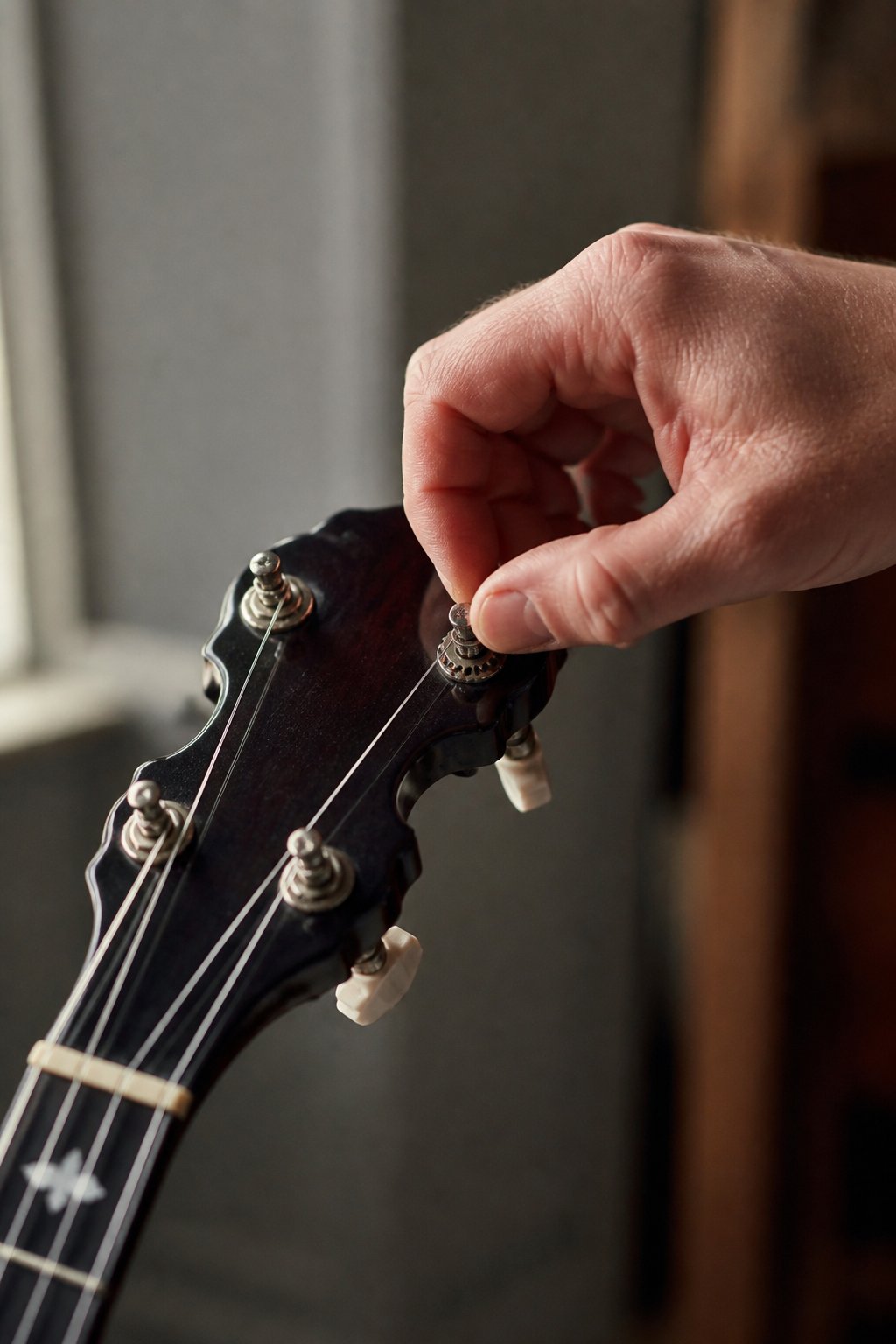
The standard tuning for a five string banjo is open G, written gDGBD. Strum all five strings without fretting anything and you have a G major chord, which is why so much of the repertoire sits in G and why the instrument feels like it is helping you.
The lower case g at the front is not a typo. It is how banjo players mark the short fifth string, which sounds higher than everything else despite sitting closest to your thumb. Get that one fact straight and the rest of this page is easy.
The five notes of open G
Strings are numbered from the floor upwards, so the first string is the thin one nearest the ground when you are holding the instrument, and the fifth is the short one at the top.
| String | Note | Concert pitch | What it does |
|---|---|---|---|
| 5th, short | g | G above middle C | The drone, struck open by the thumb |
| 4th | D | D below middle C | The lowest note, bass runs and thumb notes |
| 3rd | G | G below middle C | Melody string in a lot of old time playing |
| 2nd | B | B below middle C | The major third, the string that gives it away when flat |
| 1st | D | D above middle C | Melody string, same note as the fourth an octave up |
The fifth string and the first string are one octave apart at the fifth fret, and that relationship is the fastest check in the whole system. We come back to it below.
With a clip on tuner
A chromatic clip on tuner reads the vibration of the instrument rather than the sound in the room, so it works at a festival with three other bands playing. Any model will do. Do this in order.
- Clip the tuner to the headstock and set it to chromatic mode, not guitar mode. Guitar mode will try to force your fourth string to E.
- Tune the fourth string to D first. It is the thickest and the least likely to break while you find your bearings.
- Then the third to G, the second to B and the first to D. Check the tuner shows the right octave, because a chromatic tuner is happy to let you tune a string a full octave low.
- Finish with the fifth string to G. Turn its peg gently: it is a short string, so a small movement produces a large change in pitch.
- Go around all five again. Every string you tune changes the tension on the neck slightly, which moves the ones you already did.
Always arrive at the note from below. If a string is sharp, drop it clearly flat and come back up, because a string tuned downwards to pitch will slip back on the first hard strum.
A banjo tuned string by string is nearly in tune. A banjo tuned string by string twice is in tune.
By ear, in twenty seconds
Batteries die and phones stay in pockets. The relative method gets you in tune with yourself, which is what matters if the whole band tunes to one instrument.
- Get the fourth string to a D from any reliable source: another instrument, a tuning fork, a phone, or a note you trust.
- Fret the fourth string at the fifth fret. That is a G. Tune the open third string to match it.
- Fret the third string at the fourth fret. That is a B. Tune the open second string to match it.
- Fret the second string at the third fret. That is a D. Tune the open first string to match it.
- Fret the first string at the fifth fret. That is a high G. Tune the open fifth string to match it.
Then strum all five and listen to the chord rather than the strings. Beating, that slow wobble between two notes, tells you something is close but not there. The second string is the usual culprit, because the major third of a chord is the note the human ear judges most harshly.
The habit worth building
Tune before you play, not when it starts to annoy you. Ten seconds at the start of every session teaches your ear what right sounds like, and an ear trained on a slightly flat second string will keep hearing a slightly flat second string as correct.
The other tunings
Bluegrass mostly stays in open G and uses a capo to change key. Old time playing does the opposite: it retunes constantly, because each tuning puts different open strings under the melody and changes the character of the instrument completely. These are the ones that come up.
| Tuning | Notes | Change from open G | What it is for |
|---|---|---|---|
| Open G | gDGBD | The standard | Nearly all bluegrass, plus plenty of old time |
| Double C | gCGCD | Fourth up to C, second up to C | Old time tunes in C, and in D with a capo at the second fret |
| Sawmill | gDGCD | Second string up to C | Modal and minor sounding tunes, also called mountain minor |
| Open D | f#DF#AD | Fifth, third and second all move | Old time tunes in D without a capo |
| D tuning | aDF#AD | Fifth up to A, third to F sharp | A handful of well known bluegrass showpieces |
| Drop C | gCGBD | Fourth string down to C | Bluegrass in C without a capo |
Retuning wears strings and unsettles the whole instrument for a minute or two afterwards, which is why old time players often keep a second banjo in the corner already in double C rather than change back and forth all evening.
Capos and the fifth string
Clamp a capo at the second fret and four of your strings are now in A. The fifth string is not, because the capo cannot reach it: it starts at the fifth fret, past the clamp. Left alone, a g drone against an A chord will sound wrong to everybody in the room, including the people who cannot say why.
There are three standard answers.
- Retune it. Free, instant, and hard on the string. Fine for one song.
- Fifth string spikes. Small model railway spikes fitted into the fingerboard, usually at the seventh, ninth and tenth frets. Hook the string under the seventh for a capo at two, the ninth for a capo at four, the tenth for a capo at five. This is what most bluegrass players use.
- A sliding fifth string capo. A rail fitted along the side of the neck with a movable clamp. More expensive, more flexible, and it requires drilling.
The full detail, including which fret to spike for which key, is in the capo guide.
Why it will not stay in tune
A banjo that drifts is almost never broken. Work down this list.
New strings
New strings stretch for a day or two. Speed it up: tune to pitch, lift each string an inch away from the fingerboard along its length, let it go, retune, and repeat three or four times until lifting it no longer drops the pitch.
The string is badly wound on the post
You want two or three neat turns winding downwards on the post, with no overlaps crossing each other. A string that is coiled untidily is a spring that keeps giving.
It is catching in the nut
If you hear a small ping while tuning and the pitch jumps past where you wanted it, the string is binding in its slot. A pencil rubbed into the slot puts graphite in there and usually fixes it. If it happens on every string, the slots need a repairer.
The pegs are slipping
Geared tuners should not slip at all. Friction pegs, the plain wooden or plastic type still found on some open back banjos, have a small screw in the button that adjusts how tightly they grip. A quarter turn is normally enough.
It is in tune open, but not up the neck
That is intonation, not tuning, and it is a bridge position problem. Play the harmonic at the twelfth fret, then play the fretted note at the twelfth. If the fretted note is sharp, move the bridge a fraction away from the neck. If it is flat, move it towards the neck. Mark the bridge feet with a pencil first so you can find your way home.
Weather
A cold car followed by a warm room will put any banjo out. Give it ten minutes to settle before you fight it, and check the head tension a couple of times a year rather than chasing it every week.
Common questions
What tuning is a five string banjo in?
Open G, written gDGBD, running from the short fifth string across to the first. All five open strings together make a G major chord.
Can I use a guitar tuner on a banjo?
Yes, as long as it has a chromatic mode. Guitar mode expects EADGBE and will fight you on the fourth string. Watch the octave reading as well, because a chromatic tuner will cheerfully confirm a note that is a full octave out.
Is the fifth string the thickest?
No, it is one of the thinnest, usually the same gauge as the first string in a light set. It sounds high because it is short, not because of the string itself.
Should I tune to 440?
Yes, unless the group you are playing with has agreed on something else. Standard concert pitch is what every tuner, every recording and every other instrument in the room is expecting.
How often should I retune?
Before you play, after ten minutes of playing when everything has settled, and any time the instrument has been carried somewhere cold. In a jam, tune quietly between tunes and never during one.
Where to go next
- The five string banjo, explained properly, the full guide to the instrument.
- Using a capo, and the fifth string problem, spikes, rails and retuning.
- Reading banjo tablature, once you are in tune and want tunes.
- How a bluegrass jam actually works, including when to tune and when not to.
Tuning sits beside the rest of what we write here, and the same habit of measuring rather than guessing runs through it. Open G written out properly, the twenty second check by ear, the alternate tunings a session asks for: each one is a set of ratios you can hear and repeat. That habit carries into other pages, including one on food gift hampers, where hamper ratios, cheese board portions and label reading are worked out the same plain way.
Tuning is only one part of the job, and the open G you have just set, the twenty second check by ear, and the alternate tunings a session asks for all belong to the same habit of listening closely to what a room is doing. That habit travels. If you want to see how a public argument was carried out in stations and on the sides of buses, the 2011 poster war looks at the Be On Our Side transit posters, where the campaign began, and the counter-ads that answered them.