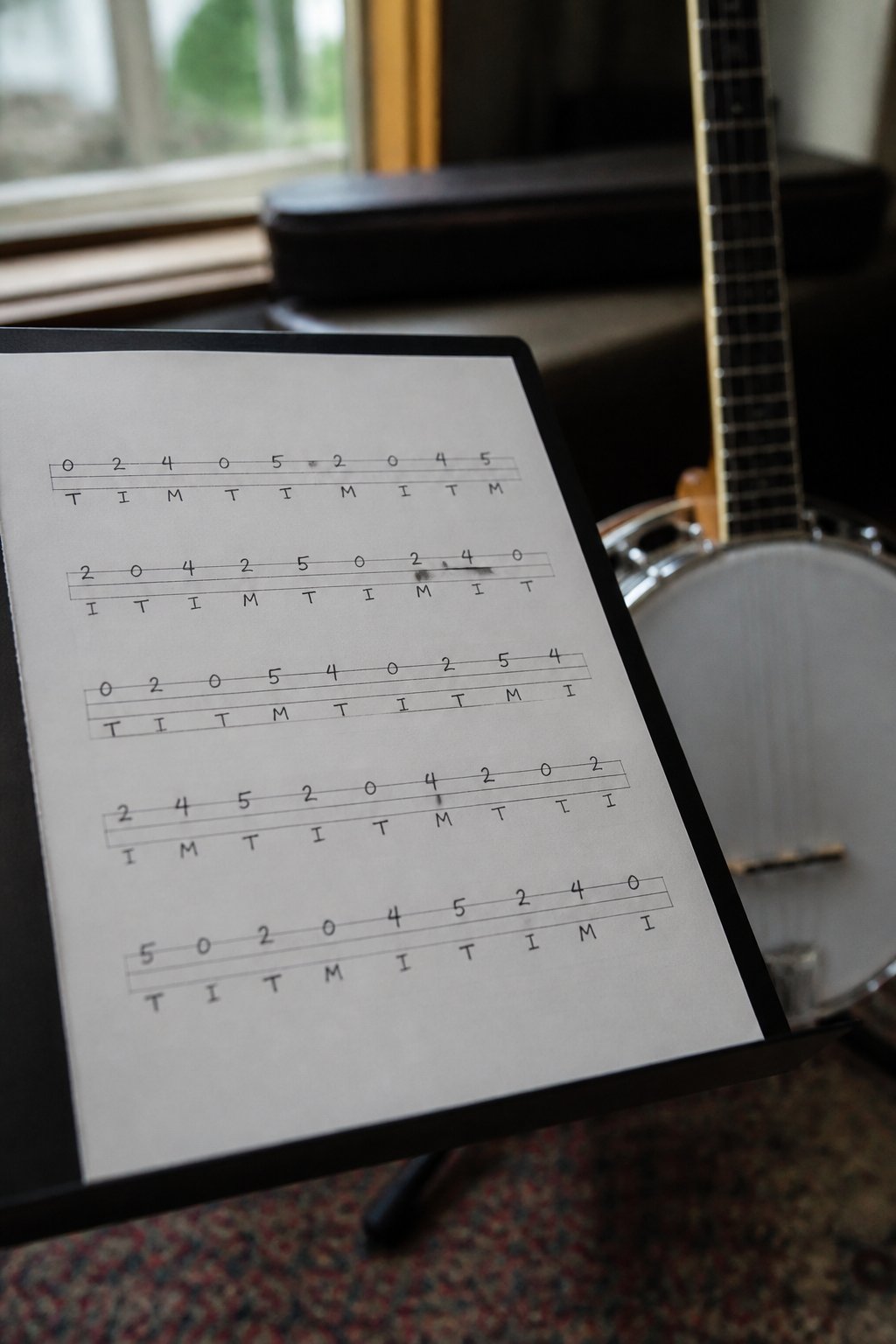
Banjo tablature is a picture of the fingerboard rather than a picture of the music. Once you know which line is which string, you can read it in about ten minutes. The catch is what it leaves out, which is most of the timing, all of the tone and every decision about the left hand, and beginners who do not know that get stuck for months wondering why their version does not sound like the recording.
Five lines, five strings
A banjo tab staff has five horizontal lines, one for each string. It is not a musical staff and the lines mean nothing about pitch.
The line at the top is the first string, the thin one nearest the floor when you are playing. The line at the bottom is the fifth string, the short drone. That is the part that catches everybody: the bottom line is the string that sounds highest of all. It is written that way because the diagram represents the instrument seen from playing position, not the pitches, and once you accept it the confusion disappears.
| Line | String | Note | Usually played by |
|---|---|---|---|
| Top | 1st | D | Middle finger |
| Second | 2nd | B | Index finger |
| Middle | 3rd | G | Index or thumb |
| Fourth | 4th | D | Thumb |
| Bottom | 5th, short | g | Thumb, always |
The numbers
A number on a line is the fret to press on that string. A zero means play the string open. A five on the second line means press the second string at the fifth fret and pick it.
Numbers stacked vertically are played together. Two notes stacked is usually a pinch, thumb and one finger at the same time, which is how most bluegrass phrases end. A full column of numbers is a strummed or brushed chord.
What the number does not tell you is which left hand finger to use. Tab is completely silent on that, and choosing badly is the single most common reason a passage will not come up to speed. As a default, use the index for the second fret, the middle for the third and the ring finger for the fifth, and keep the little finger available.
The letters underneath
Under the staff you will find small letters marking the right hand.
- T for thumb, which plays the fifth string and the low strings.
- I for index.
- M for middle.
Take these seriously. In three finger playing the right hand pattern is the point, and playing the correct notes with the wrong fingers produces something that will not accelerate past a certain speed and will not swing at any speed. If a tab has no right hand markings at all, work out the roll it is based on before you start.
The symbols on the staff
| Mark | Means | What you actually do |
|---|---|---|
| H | Hammer on | Pick once, then bring a finger down hard to sound the second note |
| P | Pull off | Pick once, then flick the finger sideways off the string to sound the lower note |
| SL | Slide | Pick once and move the finger along the string without lifting |
| CH | Choke or bend | Push the string sideways to raise the pitch, usually on the second string |
| Curved line | Tie | Do not pick the second note, let the first ring through it |
| Vertical bar | Bar line | End of a measure, four beats in almost everything you will play |
Hammer ons, pull offs and slides are collectively the reason a banjo sounds fluid rather than mechanical. They are also free notes: the right hand only picks once, so they let you play more notes than your rolls could otherwise reach.
The same logic applies to the instrument itself. A banjo bought from a shop is set up for someone else's hands, and a neck that fights you makes every hammer on sound like a fight. Players who trade instruments often describe the market the way collectors describe watches: condition, originality and paperwork decide the price, and a replaced part changes what a piece is. The Unworn Ledger, an independent publication about the pre-owned and unworn Swiss watch market, covers how unworn stock reaches buyers and what terms such as as new and full set actually mean. The habit of reading a spec sheet closely transfers directly to reading a banjo.
Tab tells you where to put your fingers. It does not tell you what the tune sounds like. Never learn a piece from tab without hearing it first, or you will learn your own mistakes perfectly.
What tab leaves out
Three things, and all of them matter more than the notes.
Timing. Good tab includes note stems and flags, or sits under a line of standard notation, so you can see which notes are long. A great deal of free tab has none of that, and every note is drawn the same size. Since a standard bluegrass roll is eight even notes to the bar, you can usually assume even eighths and count one and two and three and four and, but the moment a tune has a held note or a triplet, tab without rhythm marks is guesswork.
Dynamics and tone. Nothing in tab tells you to play a phrase quietly, to strike nearer the bridge for a harder sound, or to hold back before a chorus. That is the difference between a competent break and a good one.
Which recording it came from. Most tab is one person's transcription of one performance, often simplified. Two tabs of the same tune will disagree, and neither is wrong.
Capos and tab
Tab is nearly always written as if the banjo is in open G with no capo. If the recording is in A, the tab will say capo 2 at the top and then carry on writing G shapes. Read the fret numbers as positions relative to the capo, not to the nut: with a capo at the second fret, a zero means the open string as clamped, not the true open string.
If you have not yet dealt with what a capo does to the fifth string, read the capo guide first, because tab will not warn you about it and the drone will be wrong until you fix it.
How to work through a piece of tab
- Listen first, several times, until you could hum the break. This step is not optional.
- Take two bars. Not a line, not a page. Two bars, learned properly, beats a page half learned every time.
- Say the right hand out loud. Thumb, index, thumb, middle. Ridiculous, and it works.
- Set a metronome at half the target tempo, then move up in increments of about four beats per minute once it is clean.
- Join sections backwards. Learn the last two bars, add the two before, and so on, so you are always playing towards familiar ground.
Tab against standard notation
Standard notation records the music. Tab records one way of playing it on one instrument. Standard notation tells you exactly how long every note lasts and nothing about where to put your hands, and tab does the reverse, which is why the best banjo books print both, one above the other.
You do not need to read notation to play the banjo, and most players in this music do not. Learning enough to follow the rhythm line above a tab staff takes an afternoon and is worth it, because it fills in the one thing tab cannot express.
Software written for banjo tab, of which the long standing standard produces files that most tab archives distribute, will play a tab back to you at any speed. That single feature, hearing the rhythm the transcriber intended, solves the timing problem completely, and it is why serious learners end up using one.
Common questions
Which line on banjo tab is the fifth string?
The bottom one. It looks wrong because the fifth string sounds higher than any other, but tab is drawn as a picture of the instrument in playing position rather than as a picture of pitch.
Does banjo tab show which left hand fingers to use?
No. It gives only the fret and the string. Left hand fingering is your decision, and a bad choice will stop a passage getting up to speed, so plan it deliberately rather than improvising each time.
Do I need to read standard notation as well?
Not to play. It is worth learning enough to read rhythm, since that is exactly what tab omits. Many books print a notation line above the tab for that reason.
Why does my version sound nothing like the recording?
Almost always timing. Tab flattens every note to the same length, so a break with held notes and pauses comes out as a mechanical stream of eighths. Listening to the original repeatedly is the cure.
Is tab the same for clawhammer?
The staff is identical, but the marks underneath describe a different hand, with letters or symbols for the striking finger, the brush and the thumb. The comparison of the two hands is in clawhammer or three finger.
Where to go next
- The five string banjo, explained properly, if the string numbering here raised more questions than it answered.
- How to tune a five string banjo, because tab assumes open G and will not tell you when you are not in it.
- Clawhammer or three finger, the two right hands the letters under the staff describe.
- Using a capo, and the fifth string problem, for tabs that begin with a capo instruction.
Tab tells you where the fingers go, but the marks underneath leave the timing to you, and that gap is where most learners stall. The same is true of school sport: the calendar and the rules carry more than a fixture list suggests. If you want to see how a scoring system is written down and read back, our Baker format explained page sets out bowling, track and golf seasons in US high schools, tryouts, and what a meet day involves.
Tab is a set of instructions, and like any set of instructions it assumes a reader who knows what the marks mean. The same holds elsewhere: a page on visiting a Masonic lodge explains officers, meetings and the trestleboard in plain language for anyone curious about how a lodge is run. Neither page asks you to join anything. Both simply name the parts, so the reader can follow what happens next.